Location: Santa Barbara County
Project Type: Restoration Planning
Status: Current
Cost: $11,245,000
Funding Gap: $7,200,000
Area Affected: 1.62 acres
Project Footprint: 0.32 stream miles
Assembly District: 37
Senate District: 19
Congressional District: 24
Project Lead/Grantee:
South Coast Habitat Restoration, Mauricio Gomez
 For more information, visit scwrp.org
The Goleta Slough Complex, located in coastal Santa Barbara County approximately six miles northwest of the City of Santa Barbara, includes the Atascadero watershed and its major tributary, Maria Ygnacio Creek. Both Atascadero and Maria Ygnacio Creeks have long‑standing, consistent records of resident trout throughout the watershed, and adult Southern Steelhead have been documented in the lower and mid‑sections, particularly along Maria Ygnacio Creek. The Goleta Slough Complex is designated as a Core 2 watershed in the Southern California Steelhead Recovery Plan (NOAA, 2012).
An original planning grant awarded to South Coast Habitat Restoration (SCHR) by the National Fish and Wildlife Foundation supported the development of 100% engineering designs at five barrier sites within the watershed. These designs were completed in 2020 with review and input from CDFW and NOAA. SCHR has continued working to secure implementation funding for all five sites, which include concrete grade control structures and concrete armoring beneath bridges on properties owned by the County of Santa Barbara and the City of Goleta. The broader project goal is to restore steelhead passage and enhance riparian habitat across these major barriers.
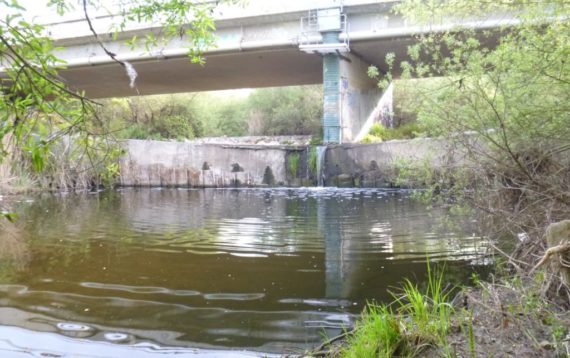
A recently completed portion of this effort focused on improving fish passage at the Patterson Avenue bridge on Maria Ygnacio Creek, a tributary to Atascadero Creek and part of the larger Goleta Slough Complex. The project implemented physical instream construction to eliminate a known migration barrier for endangered Southern Steelhead Trout. Work included modifying the underside of the bridge and installing a fish‑passage design that removed the previously existing jump barrier caused by the hydraulic jump that had scoured the confluence pool.
Construction began in August 2025 and was completed in early December 2025. Riparian revegetation was carried out in collaboration with the California Conservation Corps from the Camarillo Center. This improvement represents a key step toward restoring steelhead access to critical upstream habitat within the Maria Ygnacio watershed. Construction to remove additional barriers in Maria Ygnacio watershed is planned for implementation in 2026, 2027, and 2030.